
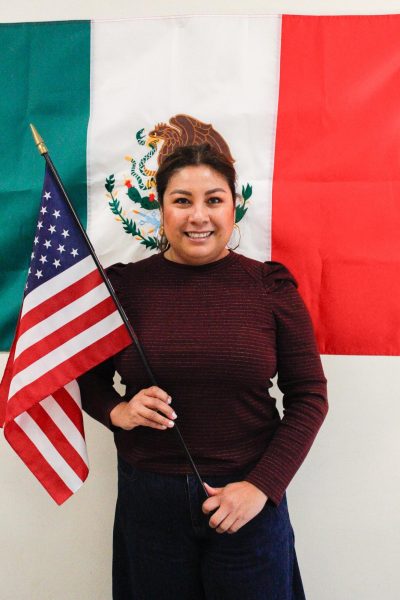
After 15 years in the United States, Spanish teacher Karina Vazquez finally became a U.S. citizen, marking the end of a long and emotional journey.
Vazquez grew up in Los Mochis, Sinaloa, living with her parents and siblings. While living in Mexico, Vazquez met her husband, Chris Callahan. Callahan’s sister worked in Mexico and was friends with Vazquez, who were introduced to each other and kept in touch. Callahan moved to Mexico because of the culture and to be closer to Vazquez. After being together for a while, Callahan brought up the discussion of moving to the United States.
“I didn’t like the private school I was working at– we could earn a lot more money in the United States and probably live a better life,” he said.
Before moving, Vazquez only had her travel visa, but she wanted to get her green Gard before moving to the States. “I didn’t want to come without a green card. So I started applying for it from Mexico and they asked for so many papers.” These documents included a birth certificate, marriage certificate, medical reports and more. During this process, she had to do an interview in-person for her green card. Vazquez and Callahan booked a hotel in Juarez for one night; one night turned into three weeks.
After getting her green card, they packed up and headed to Charlotte, North Carolina, the town Callahan grew up in. Getting her citizenship wasn’t something on her mind at the moment. “I did not feel that it was necessary yet,” Vazquez said.
It was a very different process for her to apply for citizenship than it was to get her green card. The difference between a green card and citizenship is that Vazquez would become an official citizen in the United States which includes being able to vote instead of just being able to live in the United States.
After 15 years of waiting, Vazquez applied online and got her test scheduled. The test is made up of two sections The English section focuses on the ability to speak, read and write in English. The civics section focuses about the U.S. which includes geography, holidays, flags, and more.
Out of 100 possible questions about civics and in the United States, they asked ten questions; only six needed to be correct. “I had to memorize a lot of the history of the United States, which was very interesting. My family would ask me questions– my daughter used flashcards,” she said. The test was particularly easy for Vazquez because she already spoke fluent English.
After getting her citizenship, she felt “a bit more secure.” It also gave her a voice, Vazquez was able to vote for the first time in the primary election for Charlotte City Council. Having this citizenship was a way to finally involve herself in the community. “With the new administration, I felt pressure, uncertainty and an urgent need to get involved, which is why I rushed to get my citizenship so I could make a difference in this country.”