


If you ask Phoenix Pohlheber what she’s learned as a stage manager, she might tell you, “Well, I learned how to use a drill.” Don’t be fooled by her modesty- this year she’s at the center of East Meck’s famously elaborate productions. To make shows as spectacular and polished as East does, it takes collaboration between all of the arts departments- art club paints props, tech crew handles all the behind-the-scenes work, dance class choreographs and all the actors bring the characters to life.
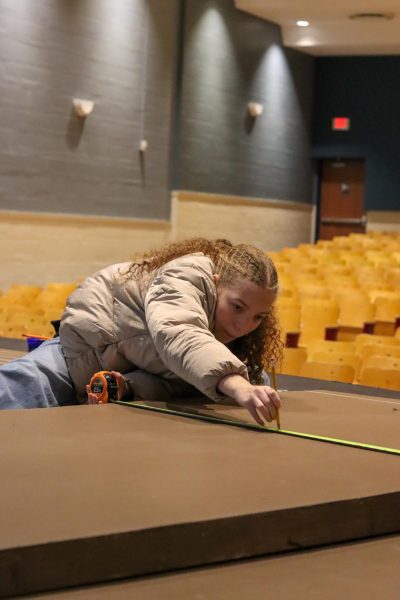
The common denominator, besides the director, is Senior Phoenix Pohlheber. Present at every rehearsal, Pohlheber’s responsibilities span the entire stage management book- a binder practically bursting at the seams.
“I write down everyone’s [stage directions]. I have to write down attendance. I have to make sure everybody knows their songs, lyrics and rhythms,” Pohlheber explains. “I have to make sure everyone knows where they’re going and that they’re being safe.”
“Phoenix is the first person that I’ve had who really wanted to be a stage manager. Like, a real stage manager,” said East Meck Theatre Teacher and Hadestown Director Bernadette Macleod. “When you work with a student as a stage manager for a while, it’s like they’re able to pick up on what you’re about to say before you even say it. I’m like ‘stop reading my mind!'”
Without Pohlheber’s presence, even in the early stages of rehearsal, everything gets tilted off its axis. In a production with hours of song and dance, lines and choreography can easily become a blur after hours of practice. Pohlheber ensures smooth rehearsal during times like these.
One day in early December, Pohlheber was unable to attend rehearsal. This just happened to be a day when the cast was focused on marking their positions on the stage, a practice known as blocking. Her absence made this process especially difficult.
Hadestown is a sung-through musical, meaning there is little to no spoken word, and everything must be timed flawlessly. One misstep can throw everything off.
Blocking can be meticulous, and actors often struggle to remember where they have to stand or which wing to enter from, especially when a musical has as long a runtime as Hadestown does. Pohlheber expedited this process, creating a reference for both the directors and the cast.
“All the actors forgot where they were supposed to be. So I went to the book,” Macleod gestured to the stage manager’s book sitting in front of her. “And sure enough, there was a Post-it note with a little drawing and everyone’s name where they were supposed to be standing. [Pohlheber] had written it all down for them.”
It’s her attention to the detail that makes her indispensable. She steps in where she needs to be, often going above and beyond to help her directors and classmates as much as possible. If you watched the musical and were impressed with the actors’ polished performances, the dancers’ slick motions or the way the stage lights moved seamlessly around the stage, don’t forget to appreciate the women behind it all: Phoenix Pohlheber.




Abigail E. • May 7, 2026 at 10:06 am
I agree that the backstage crew and the stage manager are vital parts of a production. Without them, the productions wouldn’t run or be as successful. My dad has shared with me his time being in the stage crew for musicals when he was in high school, so I’ve had an inside look through him and my friends who are in the stage crew now at East Meck. I think that the stage crew should get more recognition for all of the work they put in, so I appreciate this article.